2026-05-27
M1 tank leak
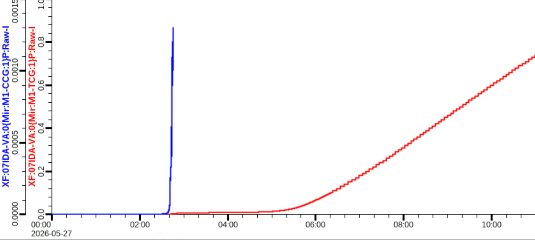
Starting at 2:00 am, there was a sudden rise in the pressure of the mirror 1 (M1) tank from 2e-7 Torr to as high as 7.4e-1 Torr. As a result, the ion pump failed, GV1 and GV2 closed, and beam is not available for both SST-1 and SST-2, as the both beam paths pass through the M1 tank.
Leak testing
Initially, a turbo cart was attached to the M1 tank on the UHV side, but the pressure inside the tank only came down to ~2.3e-3 Torr (~1e-5 Torr on the Turbo cart), which is not sufficient for beamline operations.
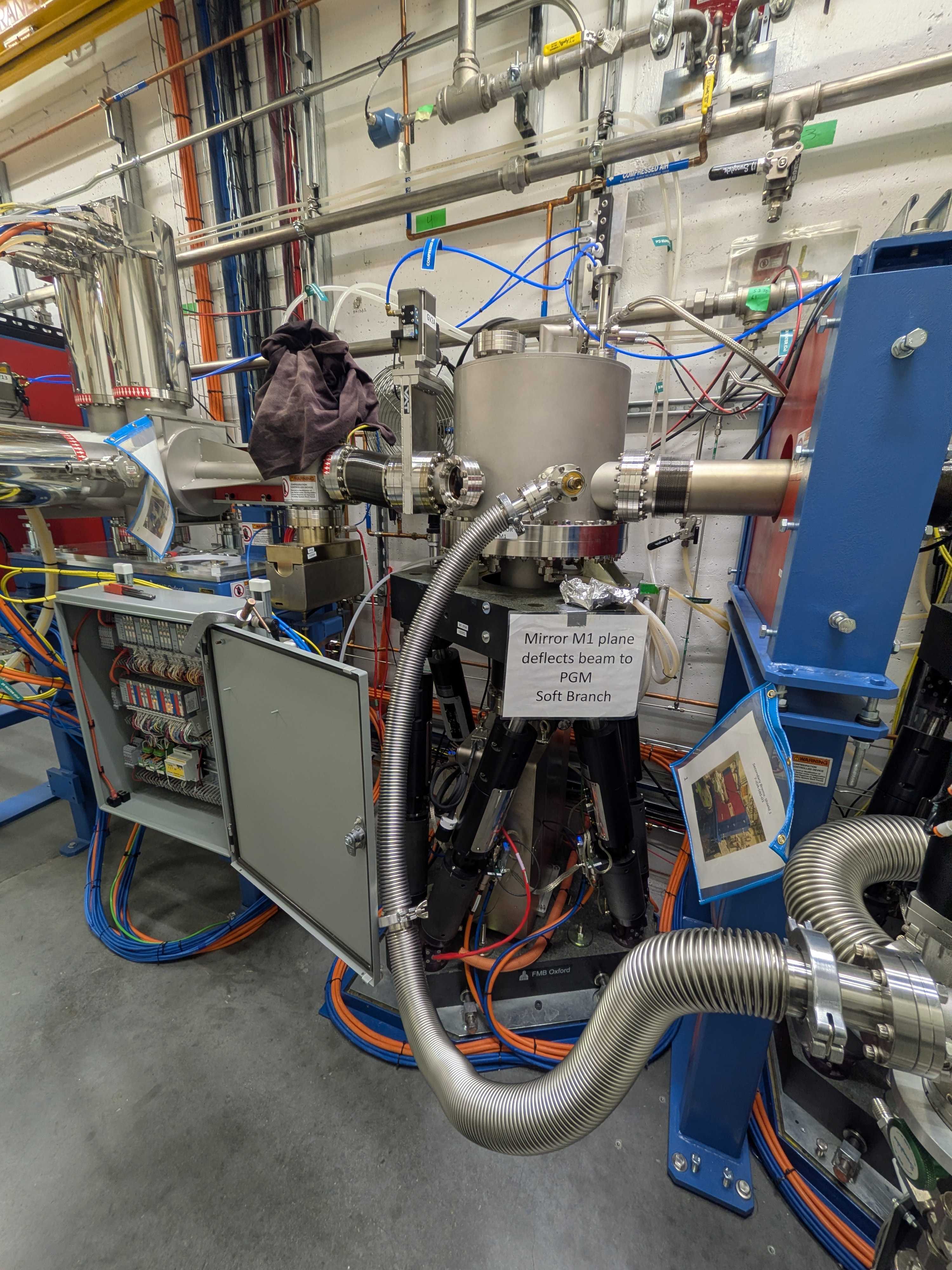
The cooling lines were investigated. There is a small port on the downstream side of the M1 tank, and this port is used for the inlet cooling line air guard. The outlet port is located on the bottom upstream side. Water was not seen actively flowing out of a hose at the inlet port, but after inserting a napking into the port, the napkin came out damp (~10 mL water).
The cooling lines were blown dry.
On 2026-05-28 morning, a turbo cart was attached to the inlet port in addition to the turbo cart that is directly connected to UHV. This brought the tank pressure to ~1e-5 Torr (and lower overnight) and suggests that there is a leak from the cooling line, gasket connecting cooling line to the mirror, and/or the mirror into the UHV region.
The pressure inside the cooling lines also was investigated, but it remained at atmospheric pressure regardless of whether or not the air guard port was being pumped. This narrows the leak to the gasket or the mirror itself.
Further troubleshooting required the M1 tank to be opened. The viewports to the tank are small and discolored from radiation (likely radiation-induced carbon deposits), so it is not easy to look inside. However, it was found on 2026-06-01 that GV1 and GV2 are leaking into the surrounding vacuum sections. It is hypothesized that radiation in the FOE has damaged the rubber gaskets on those gate valves; although the gate valves should not receive direct beam radiation, it may be receiving significant scattered beam radiation. The M1 chamber was eventually vented after attaching turbo carts to the upstream L1 chamber and turning off the L1 ion pump. The downstream Slt:WB also was vented, and GVs 3 and 13 did not leak.
M1 was removed, and the cooling lines and air guard were disassembled for further investigation. Significant rusting (reddish-orangish-brown colored contamination) was found on the SERTO fittings. The knife-edge on the brazed flanges was significantly damaged. After confirming with InSync (mirror vendor) that the cooling lines and airguards could be pumped down to ultra-high vacuum, leak tests were attempted. The flange showed sufficient sealing, but it was unclear how long the seal would last given the visible damage to the knife edge. However, the SERTO fittings were unable to be resealed, likely due to corrosion.
During troubleshooting, it was found that SST-2’s L1 mirror that is directly upstream of SST-1’s M1 also showed similar leaking in the cooling lines. However, this leak was found early enough such that the mirror was not damaged. New tygon tubes will be installed for the shorter term, and sturdier metal tubes will be installed during the shutdown.
M1 was shipped to InSync on ~June 15, 2026 for further inspection on both the vacuum seals and the mirror itself for any potential damage from uneven heat load.
For reference, a similar issue had occurred recently (mid-May 2026) at the CSX beamline. Both SST-1 and CSX have stainless steel flanges, SERTO unions, and air guards, which were expected to minimize corrosion. Both beamlines had a leak through the copper gasket (likely from the water dissolving the copper). Both beamlines showed significant contamination at the leak site. In this case, water leaked at the copper gasket that directly interfaces between the water hose and the mirror. One hypothesis was that the similar timeframe of these leaks may be the result of compromised cooling water quality. However, SST-1 uses house DI water, whereas CSX uses distilled water from a chiller. In the past, CSX had used a different water/chiller system and had algae growth, but migration to their current chiller system has eliminated water contamination. CSX and many other beamlines prefer slow water flow for stable cooling, whereas SST-1 cooling lines have faster water flow. CSX’s mirrors also showed significant green corrosion (likely copper oxide from the gasket) with a lot of contamination inside the cooling lines. SST-1’s M1 showed reddish-orangish-brown colored rust (possibly from iron on the wires used to clamp the tygon tubes to the fittings) on the outsides of the fittings with only small amounts of contamination inside the cooling line.
Ion pump testing
With the M1 tank pumped to ~3.9e-6 Torr by 2026-05-29 morning, it was attempted to turn on the ion pump. However, the pressure quickly rose into the e-4’s/e-3’s, so the ion pump was immediately turned off.
The M1 tank will be pumped down using the turbo carts over the weekend, and it will be attempted again to turn on the ion pump during the next week (2026-06-01).
The M1 ion pump is located in the center of a hexapod assembly that is used to move the M1 positions. Thus, pump repair/replacement would require the entire hexapod assembly to be removed. By testing the ion pump sooner, any repairs can be coordinated early on.
Next steps
During pumpdown to resume SST-2 operations, the M1 tank’s ion pump will be tested to ensure that it functions properly. Theinterior of the chamber will be inspected visually prior to pumpdown for obvious leaks and signs of damage.
M1 will be examined by InSync. InSync will provide metal cooling lines to replace the tygon tubing originally used. Likely, InSync can provide a second pair of metal cooling lines to install at SST-2 during the upcoming shutdown. If the repairs are minimal, the M1 might be returned in 2-3 weeks (by ~end of June 2026). However, if repairs are extensive, they can take 2-4 months, putting SST-1 out of operation for the entire cycle.